Activation of enzymatic catalysis via nucleic acid hybridization affords synergistic coupling of specificity, potency, and signal amplification
Montasell, M. C., Raeven, L. M. V., Malm, M. R., van Hest, J. C. M., Zelikin, A. N., Activation of enzymatic catalysis via nucleic acid hybridization affords synergistic coupling of specificity, potency, and signal amplification, Nat Commun, 2025, 16, 9638.
DOI: https://doi.org/10.1038/s41467-025-64636-z
Abstract
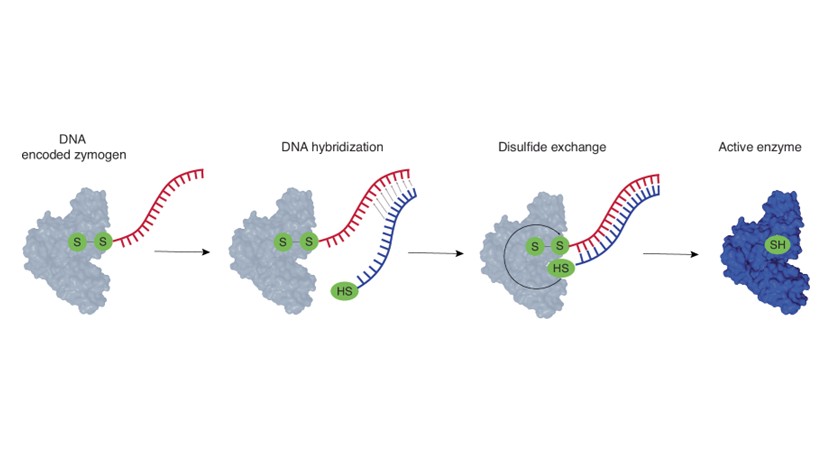
In this work, we establish the use of nucleic acid hybridization to program the activation of catalysis in enzymes. We do this via “thiol switching”, using thiolated oligonucleotides: a protein is inactivated by conjugation to an oligonucleotide via a disulfide linkage; hybridization of the thiolated complementary oligonucleotide ensues disulfide exchange, the liberation of the enzyme, and the activation of enzymatic catalysis. In doing so, we couple the most specific recognition event (hybridization) to the most effective tool of signal amplification (catalysis). As potential applications, we illustrate the use of hybridization-activated catalysis for programming the specificity of activation for one specific enzyme and engineering of Boolean logic elements. For biosensing, we illustrate the sequence-specific detection of a target oligonucleotide at a nanomolar level, in the presence of gram quantities of genomic nucleic acids, using simple mobile phone camera. We anticipate that this technology will find use in diverse areas of biotechnology and biomedicine.